Here I am with legendary blues musician John Mayall. He was performing at the Orpheum Theatre, in Flagstaff, AZ. last Saturday night, and I was there!
I think this picture is fuzzy because I am grinning so hard. I had just bought his latest CD, " Find a way to Care". He was nice about a photo shoot. I love the blues and had listened to this man and his various band incarnations since the 1960s. Mayall played with all the best musicians back then, and still does, including his present band.
What is so fine is that his voice is still strong; his fingers very nimble, and he does a mean mouth organ. The guy is 82 years young and still making his art and taking it on the road.
So that got me thinking. We artists really have job security, if we want it. All that experience in learning our craft, is there any reason to ever stop creating? There is always a chance to do a little better on the next piece; another show to enter out on the horizon. Maybe we are not only getting older, but better.There's a hopeful thought.
 I have been making porcelain wind chimes again. For me, it is a kinetic art form, as well as one of the first musical instruments. Thin, texured pieces of porcelain are rolled and cut out, fired once, and then again at a very high temperature with the color added.
Here I added small, turquoise creatures and beads for a specific client's order. I chose the earth tones of iron oxide. However I have used cobalt blue, and am working on a green hued chime at present.
I included a picture of me holding them outside in the sunlight. I use fishing line so there is the appearance of all the pieces floating in the breeze. I love the sound that the clay creates as the wind makes them dance.
Historically, wind chimes have been found in Africa, dating back to 3,000 BC. Early models were made from natural found objects, such as bone, shell, or bamboo. later The Chinese passed them onto the Japanese, and then to the western world in the 1800's.
There is something very soothing and meditative, hearing the sounds of the small pieces of porcelain ring against each other. I guess it is a sound of summer, which has finally arrived here in Sedona.
I have been making porcelain wind chimes again. For me, it is a kinetic art form, as well as one of the first musical instruments. Thin, texured pieces of porcelain are rolled and cut out, fired once, and then again at a very high temperature with the color added.
Here I added small, turquoise creatures and beads for a specific client's order. I chose the earth tones of iron oxide. However I have used cobalt blue, and am working on a green hued chime at present.
I included a picture of me holding them outside in the sunlight. I use fishing line so there is the appearance of all the pieces floating in the breeze. I love the sound that the clay creates as the wind makes them dance.
Historically, wind chimes have been found in Africa, dating back to 3,000 BC. Early models were made from natural found objects, such as bone, shell, or bamboo. later The Chinese passed them onto the Japanese, and then to the western world in the 1800's.
There is something very soothing and meditative, hearing the sounds of the small pieces of porcelain ring against each other. I guess it is a sound of summer, which has finally arrived here in Sedona.
Here is my latest ceramic creation entitled " Abstract Celebration", a wall triptych that is currently hanging in Jerome, Arizona. Rather a large piece,it covers over four feet in length and about 13 inches across. Adorned with seed beads, there is some sparkle to my black, gray, purple and red palette.
It is a celebration, for a show by that name at the Jerome Artists' Cooperative, where I am a member. This gallery is a true coop, owned and manned by the artists.This exhibition offered a chance to do something quite different for us all.
I like to work big, but kiln shelves have their limits. I knew I wanted a rather defined, abstract feel to this piece, since this has been a recurring theme in my ceramics over the past few years.
Using low fire glazes gave me this ability , and I mixed the black and the white for this gray tone. It was a pleasant surprise, even for me. Making it took weeks. Thin, large creations need to dry slowly; uncovering a bit more every few days. They must be handled carefully. Even finding the work space was a challenge in my studio. I wanted a feeling of motion, so the raised ribbons of color add the kinetic feeling I was after.
The true celebration comes when the kiln is opened and the creation is close to what I envisioned. With ceramics, there is often the element of surprise, even for the artist!
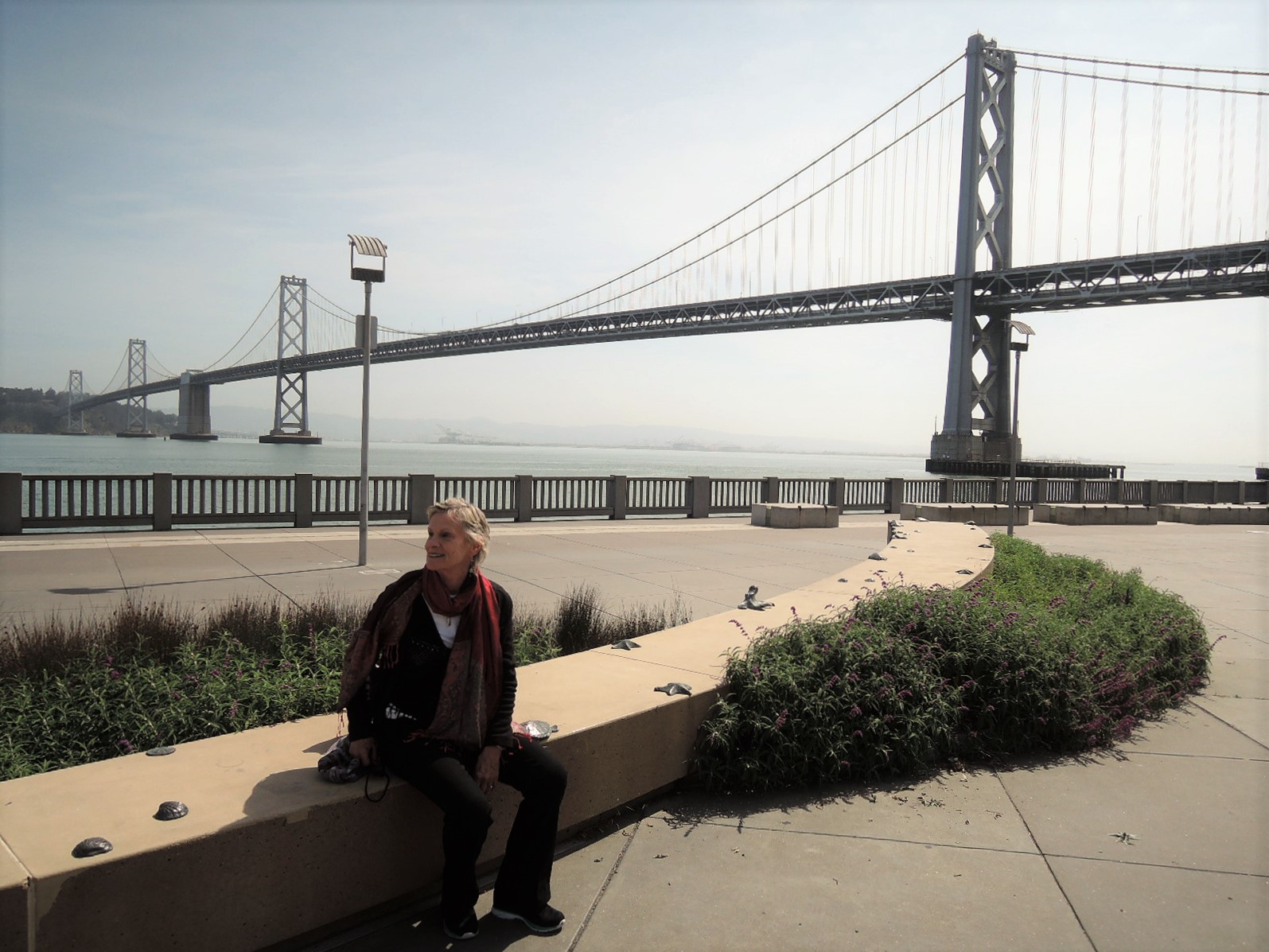
Here I am at the Embarcadero in San Francisco, city of bridges. This was the last stop on my California voyage.There is also a wonderful Claus Oldenburg sculpture of a bow and arrow, quite large of course, down from where I am sitting. From the ferry building to Fisherman's Wharf is this promenade along the bay. You may walk , or take a trolley. You soon learn it is always necessary to have exact change for all public transportation.
I found this to be a city which contains so many elements of art and design right in the public view. There are the buildings themselves: new and hard edged; full of curlicues and ornament, which their colors accentuate; influences of the Chinese culture, everywhere evident. Then there are the old warehouses,with their dirty glass windows and massive size against the sky.
We visited an artist friend in the Mission district, who has his studio in the old Hellman factory. He was one of a group of artists who bought this building years ago, and pay a reasonable maintenance rent. It is an entire building filled with such creative efforts. This was a real joy and inspiration for me.
I have been visiting this city since the 1960's. I miss the element of low rent and slight decay that used to reside in certain areas. I can't imagine it is possible to find reasonable space to live and work there today. The technology boom has made this an even more desirable place to live, and it felt like New York prices for everything we ate or did. There is a price to pay to live in a city which is the art.
Here I am tucked behind Rodin's sculpture " L'homme qui Marche," in a place I once held dear. This is the Franklin Murphy Sculpture Garden at my alma mater, UCLA. On a recent trip to California, I wanted to show friends the site where I used to hang out.
This garden, started in 1967, is named after the university chancellor of that time, which was when I transferred to this school. My diploma hangs on my wall, signed by the then governor, Ronald Reagan. Covering five acres of grass and trees, there are more than 70 sculptures by world known artists. I had never been able to lay my hands on a Henry Moore before then. The library, art, and history buildings were all up in that area.This was where I spent a lot of my time.
There is still an outdoor eating terrace, with tables and chairs to while away endless hours. Called the Gypsy Wagon when I went to school, formerly there were trailers that served the junk food, the coffee, we all needed to be better students. Plus it was a fun place to practice Flirting 101.The tables are still there, but today the food is in vending machines.How can you get your french fires from a vending machine?
You could take your food up to the gardens and lie on the grass, or sit on the low cement walls. The design of the garden is a piece of work unto itself.
I remember a sense of awe and excitement to see in person what I had only viewed previously in my art books. Even today, it is a respite of peace in a busy place. It is on campus, but open to the public. A worthwhile visit.
Cobalt blue, porcelain buttons. Who knew what this ceramic artist could come up with to fill my kiln?
I am a bead maker.These are transformed into jewelry. It wasn't a far step to see my rolled out textured slab cut into different round shapes. These were created to sell at the Jerome Artists' Cooperative, where I show my ceramics.
Buttons have been around as long as clothing. Since prehistory, people have made them from stone, shell, horn, and yes, ceramics.From the crusades, the art of buttons were imported from the near east. Mostly it was the men who used them, to fasten their sleeves, their jackets.By the mid 1800s , the industrial revolution made them available to the masses. Queen Victoria always had her jet black buttons.
There has always been a market for the original, hand made style of this fastener. They work well on knit fabrics, shawls and sweaters,and serve to individualize clothing. Mine fall into this category. No matter how I would like to standardize, each shape I create is hand carved, hence original. Each texture is similar, but how the stains apply has a personality.
I use three colors made from oxides: a cobalt blue;brown from iron oxide, and a soft green, from chrome. These are high fired and will stay on forever. I have done my product testing, and use them in the washing machine without breakage. The rough and tumble of the dryer is against my written advice.
I mount my buttons on a hand lettered display cards. They are little pieces of art, in case it takes you a while to get around to sewing!
I have seen the Ravens flying in the sky above Sedona this spring. Here, I guess they are hanging around on my sky blue platter that recently came out of the kiln.
The Common raven, Corvus corax, are large birds, some 24 inches in length.Young birds may travel in flocks, but later mate for life. It is no accident I chose to draw this twosome. Intelligent birds, they have long been a part of folklore in many countries. I remember seeing ravens on the top of many totem poles in Alaska, held in high regard by native tribes. They have shiny black feathers, with a wedge shaped long tail and bill.
Creating an exact replica is challenging with clay. I must first carve the silhouettes, before adding the glaze. Four coats of "painting within the lines"... difficult. I chose the pale blue background to evoke the natural background in which we see these creatures. However it is not uncommon to see them resting on a branch, and this is my representation here.
As with all my " critter pots" I am hoping to evoke feelings, and connection to these creatures, as they perch on my ceramic platter.