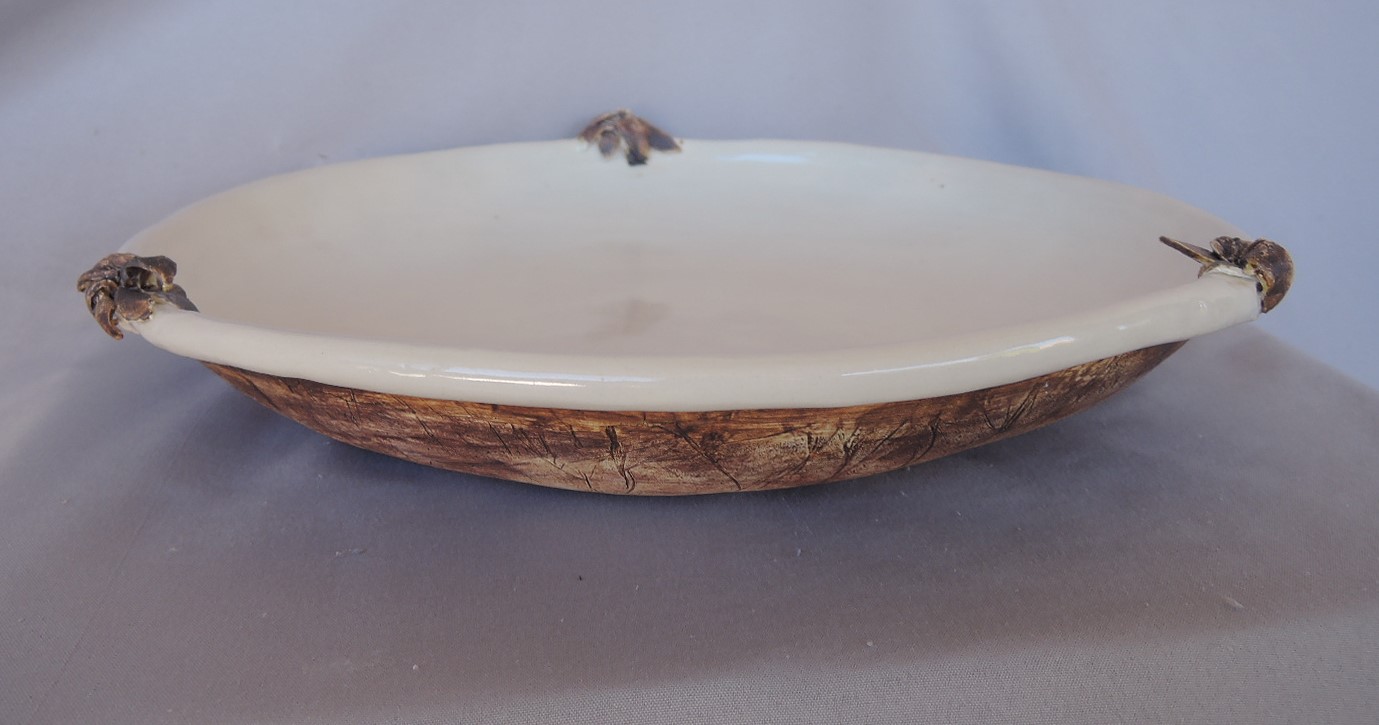
Here I am inspired by flowers, once again. Spring is in the air and I love having blooms inside as well as out . In my last blog , I shared how I made petals out of clay, as a decorative touch on my porcelain bowl.
I had these beautiful orchid stems, plus a few other flowers I wanted to display. What to put them in?
I had an idea to make sort of an oriental arrangement, so that each individual bloom would be visible. To me this meant something rather low.
I know of the ancient form of flower arranging called Ikebana, which I used as inspiration. They include: embracing the asymmetrical form; use of empty space as part of the composition; and harmony among the materials, container, and setting.
I was perplexed on which container to use.
As I looked around, I spied this luscious, purple bowl I had thrown. The color was perfect to reflect the orchids. I chose three pieces of quartz from my garden to hold things in place, and bring balance. Often I use it for eating my salad, but doesn't function follow whatever form we choose?
So there was my answer. My bowl was more than just a bowl.
Saturday, March 19, 2016
Friday, March 4, 2016
The Ceramic Flowers of Spring
I like the whimsy of flowers, so I add them to my ceramics. This is my handmade bowl that I decorated with three, distinct ceramic blooms. Odd numbers seem more pleasing to my eye. Not only are there individually created petals, but in the center the tiny stamens are visible.That makes me smile.
It is a larger vessel, measuring twelve inches in width, and about two inches high. I try to make it as thin in weight as I can. No modern machinery for this artist. Every slab of porcelain is hand rolled with my old fashioned rolling pin, and then shaped in a form. I admire the look of the low and lean container. It can rest on a table, or be displayed in a stand to admire. Like all my high fired bowls, it is totally lead free and food safe.
People refer to this as a " white" bowl, which it is. The fun aspect relates to the fact that you are actually looking at the color of the clay itself: white, high fired porcelain with a clear glaze over, making it permanent and functional. On the outside is the iron oxide stain which shows on the flowers. I see this color every day on the red rocks of Sedona, where I live, and create. This is truly a bowl of nature.
Friday, February 12, 2016
Sedona Artist: The Art of Doing Not Much
Sedona Artist: The Art of Doing Not Much: What a nice image. To do nothing. A white porcelain wall plaque, with cobalt blue lettering, hanging right before you to amuse and inspir...
The Art of Doing Not Much
What a nice image. To do nothing. A white porcelain wall plaque, with cobalt blue lettering, hanging right before you to amuse and inspire.
The Spanish saying so makes me smile, that I put it into a permanent, high fired ceramic art form. This style of calligraphy is called " Brush lettering" , done with a rather small brush, held at an angle. Harder to write on clay than on paper, with its irregularities.
As of these past few weeks, I have been required to live this lifestyle. It is called " healing". I had a bit of surgery and the prescription is as follows: Do nothing; rest a lot; ice and elevate; rest a lot.
It makes me aware that doing nothing is the most fun when the time and place is of your own choosing. Having to do not much of anything when it is necessity rather than choice, now there is the real test of this art form.
It is something to think about. Everything is a real joy when we choose it. Having to do something, even when it is nothing, well there is the challenge.
Tuesday, February 2, 2016
Teaching a New Book
Here I am with my sample book from the recent workshop I facilitated here in Sedona. I am sharing a method of creating a book composed of single sheets of paper. The sewing technique has an exposed Coptic stitch binding when completed. To those who have never made a book, this may sound rather esoteric. Simply put, you sew each page to the one before it, then every two pages you loop together. This shows as a nice braided, Coptic, stitch on the spine. A thicker bookbinding or embroidery thread is used. Of course it is never Quite that simple. You must be very careful not to rip your pages as you tighten them. I chose to make a paper cover, of a heavier stock than the pages. Covered mat board will also work, and can be more durable.
Since I had no words in this book, I wanted to add embellishments, such as this pocket on the corner. I like books where you tuck in a little something. For paper, here is the same pattern that is on the cover, where I added a few gold metallic pipe cleaners that came out of my wrapping box. You just never know what you need until you find it!
I think the most fun is to see how you give six individuals the same assignment, and the creations that arise are completely different and intriguing. It is always a lesson for me when I teach.
Saturday, January 23, 2016
Viewing the Eddie Basha Collection
Here I am in front of a sculpture by Sedona artist Susan Kliewar, at the Zelma Basha Salmeri Gallery in Chandler, AZ.
For those of us from Arizona, we recognize the name Basha from the grocery stores around the state, including the one in my home town of Sedona, AZ.
Eddie Basha began collecting art as a hobby during the 1970's under the guidance of his Aunt Zelma, hence the gallery name. He focused on western and American Indian Art. Truly, I have never seen so many Joe Beeler bronze sculptures; paintings and cartoons in one location.
Beeler was a founding member of the "Cowboy Artists of America" , well represented in this collection. This group started here in Sedona,while in the Oak Creek Tavern. Now an upscale restaurant, it was the local bar with tacky red vinyl booths and a stuffed poler bear in the corner. I remember it well. Ah those were the days. Living in Sedona for thirty years, I am, and have been acquainted, with both Susan and Joe.
The Basha Collection is housed at the corporate headquarters, which has been there since the 1930's. Walls of covered adobe give the collection an historical setting. Small rooms; hallways, and nooks, are painted vibrant colors to better show off the paintings; sculptures; baskets, and ceramics. The Gallery Director, who I had previously met, was kind enough to give us some more insight into the man who created this gallery, and the fun he had collecting.
Admission is free, and it is open most days from 9 to 4 pm.
Subscribe to:
Posts (Atom)